
Who Gets Involuntarily Committed?
A new demographic study suggests avenues for reducing coercion in mental health systems

We know very little, in aggregate, about “who” is being involuntarily committed in North America. As far as I’ve seen, only Florida is currently doing systemic tracking of all forced hospitalizations in the state and reporting annually in ways that include some basic demographic information about detainees. Colorado actually stopped collecting most demographic data in 2018. As I reported last year, California has established a plan for some of the most comprehensive tracking and public reporting we’ve ever seen anywhere — let’s hope they follow through.

Otherwise, we can only look to occasional reports and studies that emerge and typically give us information about only small pieces of the puzzle—such as about psychiatric detainees in one institution, or in one city, over a short period of time.
It’s an appalling state of affairs. Compare it, for example, to how much we know about inmates of prisons and jails—about who they are, what charges got them imprisoned, how long they’re jailed for, and so on, as exhibited on the Prison Policy Initiative (PPI) website.
With so little knowledge, no one should feel at all comfortable promoting the continuation — still less the expansion — of civil psychiatric commitment.
But for these reasons, the occasional formal demographic studies of involuntary commitment that do emerge are all the more important and worthy of discussion.
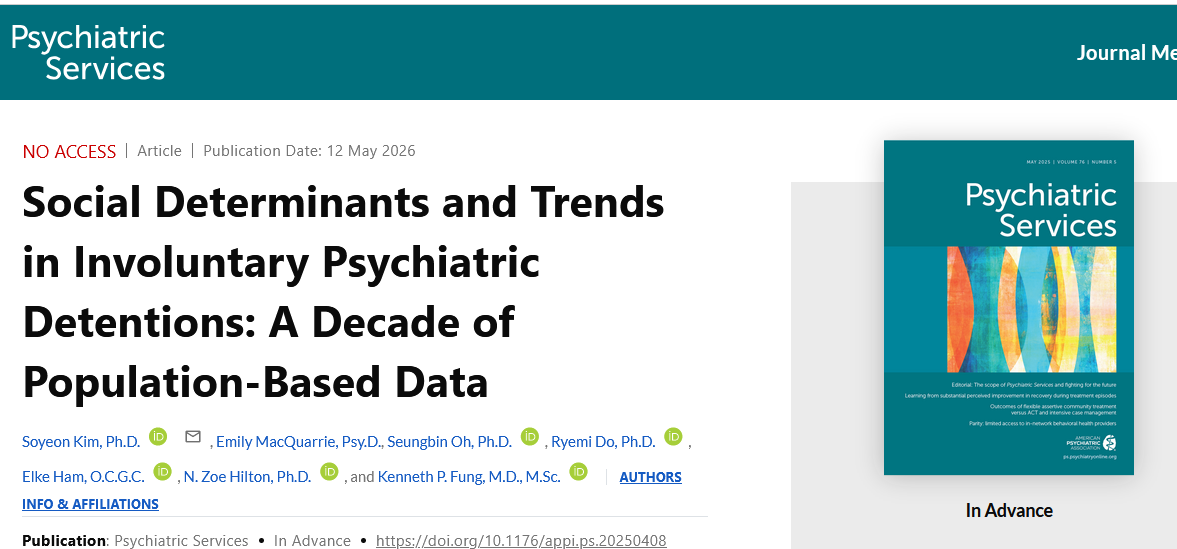
A new study
Psychiatric Services is a journal of the American Psychiatric Association which, to its credit, has provided a home for some important research and critical opinions on involuntary commitment in recent years. Last month, the journal published a new, long-term, large-scale demographic study out of the province of Ontario, Canada.
It provides interesting insights. The authors also suggest — rightly, I believe — that their findings could be used as guidelines to help reduce psychiatric coercion.
Titled, “Social Determinants and Trends in Involuntary Psychiatric Detentions: A Decade of Population-Based Data,” the study was led by Soyeon Kim and other researchers mainly from the Waypoint Centre for Mental Health Care and the Department of Psychiatry and Behavioural Neurosciences at McMaster University.
The researchers analyzed tens of thousands of psychiatric admissions from 2013-2023 across nine major psychiatric facilities in Ontario, including the four largest psychiatric hospitals, which together account for two-thirds of the province’s psychiatric beds. And Ontario has over 16 million residents, more than a third of the entire population of Canada, so, all in all, it’s a very “representative” study.
Some clarifying caveats
If someone was detained repeatedly in the same year, though, the researchers counted that as only one detention. It’s an understandable decision for a demographic study: The researchers didn’t want the detention of, say, one Indigenous person ten times in one year to look like detentions of ten Indigenous people that year. However, this also means that, in their data, ten detentions of one Indigenous person in one year looks the same as one detention of one Caucasian person. So, unfortunately, we don’t learn anything about the demographics of people who are being repeatedly detained.
That said, overall, as has been found in other studies, repeated detentions of the same people in any one-year period were a relatively small percentage of the totals, so it likely did not skew the rest of the study’s data too much.
The authors also made the curious decision to completely separate out 72-hour detentions (under Ontario law offically involuntary psychiatric “assessments”) from 2-week detentions (called involuntary “admissions”), including in their calculations and analyses. This fostered some interesting speculations from them about what might be making certain categories of people more likely to be detained longer either right out of the gate or after the 72-hour hold, but also, it seems to me, obfuscated some of their data and potential findings. So, I’m recounting here only the findings that seemed the strongest.

The demographics of psychiatric detentions
Even after that pruning out of repeated detentions of the same people, the rates of involuntary detentions per 100,000 population — as we’ve seen in many other jurisdictions across North America — have been going up and up. Specifically, the researchers found that involuntary admission rates in Ontario increased on average by 3.3% annually during the decade, “signaling a significant rise in coercive psychiatric interventions.”
And what were some of the main demographic traits that made people more likely to get detained?
Recent and long-term immigrants had higher odds of involuntary admission (adjusted odds ratio [AOR]=1.37 and 1.51, respectively).
Indigenous identity (often referred to in the U.S. as Native American) was associated with a three times higher likelihood of being forcibly detained for psychiatric assessments (AOR=3.06). This was especially notable, the authors wrote, because Indigenous peoples represent only 2.9% of Ontario’s population but accounted for 10.7% of involuntary psychiatric assessments.
Being homeless or having no income were associated with increased odds of being forcibly detained for psychiatric assessments (AORs=1.73 and 1.11, respectively) and with longer-term involuntary admissions (AOR=1.87 and 1.43, respectively). The researchers also noted that homeless people are estimated to make up only about 0.5% of Ontario’s population—yet they accounted for 9.4% of involuntary psychiatric assessments and 10.1% of longer-term involuntary admissions.
Conversely, if a person had a post-secondary education, that made them less likely to be detained.
All of this is fairly basic demographic information. But, in its way, it’s extremely informative—especially when we look at the common themes and overlapping issues linking these numbers.
The common issues
Reviewing psychiatric detentions occurring among nearly one-third of Canada’s population, we see that immigrants, Indigenous people, unhoused people, and those with lower education or lower income are all more likely to be either forcibly detained for psychiatric assessments or involuntarily admitted. What are some commonalities across these groups?
Immigrants who are leaving behind their lives, jobs, and communities, often fleeing poverty or war, and not uncommonly arriving isolated, without supports, and perhaps traumatized.
Indigenous people with high odds that they’re living through intergenerational trauma in the wake of colonial oppression, forced resettlement or displacement, families torn apart by enforced residential schooling, experiences of childhood abuse, and reserves suffering some of the worst poverty and drug and alcohol problems in the country.
Homeless people — statistically more likely to be victims of childhood abuses, immigrants, and/or Indigenous — living through the daily frustrations, fears, dangers, brutality, and violence of eking out survival, isolated on the streets.
These commonalities were observed by the researchers as well. They highlighted it in their paper’s title: these are “social determinants” of involuntary commitment. It’s not about bad genetic predispositions or minds that are fundamentally deranged — it’s about people suffering enormously, and very understandably and relatably, through terrible circumstances.
Instead of subjecting these people to stigmatizing mental illness labels, forcibly confining them, and drugging them against their will… Maybe we could try harder to assist in alleviating the stresses of their circumstances?
The researchers also suggested this. “Overall, these findings underscore the importance of addressing social factors, including housing, income, and education, to enhance mental health outcomes and reduce reliance on involuntary care,” the study’s authors wrote. “Policies that address upstream social determinants, such as housing and income support, and ensure culturally safe preventive care are needed to reduce coercion and promote equity.”
Indeed!
Basically, this data strongly suggests that a better (and usually much more economical) approach to helping people would be to give them housing, social supports, and other services that help facilitate stability, genuine community connectedness, and a sense of possibility for their future—rather than paying the typical $30,000 or more per person to detain distressed people at psychiatric institutions for a few weeks and then spit them back out.
It seems obvious, doesn’t it?
But seeing this data, reading the researchers’ sensible analysis, one realizes why so many psychiatric practitioners, institutions, and other supporters of involuntary commitment are not calling for more and better data. Because, whenever we get good data, it tends to expose the systemic biases and prejudices at work. The data tends to make practitoners in aggregate, and the involuntary commitment system as a whole, seem prejudicial, classist, racist, sanist, and abusive.
Imagine the societal transformation that could take place if we simply assessed the social/economic needs of the distressed and gave them the money, rather than the coercive system! Most of the so-called psychiatric problems would likely take care of themselves. For the same or far less costs. Sadly, we will never do that.
Rob’s sad conclusion: “The data tends to make practitoners in aggregate, and the involuntary commitment system as a whole, seem prejudicial, classist, racist, sanist, and abusive.” shows that our society still has a very long way to go. Thank you, Rob.