
Psychocracy is Spreading
The UK's information-access law, US government proposed social media bans for youth, and Canada's medically assisted suicide debate have something dangerous in common

The United Kingdom’s Freedom of Information Act (Section 38) allows government agencies to refuse to release information to the public, if that information “would, or would be likely to endanger the… mental health of any individual.”
The first time I read that (it was introduced in 2005), since few others seemed to raising a ruckus, I assumed my anxieties about it had to be overblown, and soon forgot about it. But recently I noticed that, more than a decade after its introduction, the UK Information Commissioner’s Office (ICO) had posted a discussion of how Section 38 can and does get applied in practice. While noting that no “clinical evidence” per se of any impacts is required, the ICO describes examples where the government could reasonably refuse to disclose information that would otherwise be public:
Someone dies—but it might upset surviving relatives to learn the facts that led to the death.
The government gathers information about suicides—but releasing that information might upset others and increase the risk of new suicide attempts.
The government health regulator has conducted studies into how dangerous an approved psychiatric medication truly is—but releasing these studies might cause some people to stop taking that medication.
I find all of this to be as ridiculous as it is outrageous, besides being grossly paternalistic. But the law’s very existence, let alone its ongoing use, is evidence of a foreboding trend that I expect to be reporting on more: The use of mental health rationales to justify, protect, and expand coercive state control outside the walls of traditional mental health institutions.
In this case, a government claims expanded powers to dictate what the public can and cannot know on the basis of a fuzzily defined, infinitely malleable purported desire to protect people’s “mental health.” Basically, it is a twisted way to subject virtually everyone to new forms of coercive mental health control. It is a harbinger of what author and self-identified reformed ex-psychologist Tana Dineen called “psychocracy,” or “governance by the psychological,” when she started to warn of its rise more than two decades ago. (Dineen’s thought-provoking essay discusses “shades” and “spheres” of influence affecting all aspects of how we see ourselves and how our society operates.)
A striking example of psychocracy in action now getting major international traction is legal bans on children and youth accessing social media. As the Electronic Frontier Foundation (EFF) has described, we’re seeing a wave of extremely broad censorship and mass surveillance bills “masquerading as ‘children’s online safety’ measures.” In the U.S. alone, EFF points to legislation in Massachusetts, Idaho, Minnesota, North Carolina, South Carolina, Illinois, and California. Meanwhile, Canada, Australia, the UK, and other countries have already implemented or are proposing versions of such bans.
EFF points to the growing shift by governments towards mental health framings and justifications for such measures. “Just a few years ago, lawmakers supporting age-gating laws insisted their efforts were narrowly targeted at limiting young people’s access to adult content,” writes EFF. But now, the justifications for social media bans are premised on the idea of protecting children’s mental health and battling rising youth suicide rates. “The current legislative push to ban young people from social media relies heavily on the idea that the “great rewiring” of the adolescent brain is a proven fact. This simply isn’t true,” writes EFF.
This effort wipes out recognition or discussion of all of the good that access to diverse views and online communities have undoubtedly done for countless teens. But EFF also outlines the problems with such bans for all of us. The proposals hinge on forcing everyone to repeatedly hand over personal data to get age-verified on social media and many other websites—either uploading copies of government photo ID and/or allowing ourselves to be photographed and our online activities to be monitored and “assessed” to reveal our likely age.
Overall, it’s a lose-lose scenario: either platforms collect new forms of our most sensitive and immutable data, or they unleash their AI and algorithms on our existing behavioral data to make creepy guesses about who we are and what we deserve to see.
EFF calls these proposals nothing less than a way to create a new “mass surveillance and censorship system.” As our governments are visibly becoming more aggressive about policing anyone they consider to be potential enemies, can you imagine all the ways such a system will get used? And it simultaneously creates many more “honeypots” of sensitive data about us for hackers to use for identify theft.
"Social media bans are unconstitutional, discriminatory, and deeply misguided. They reinforce existing structures of oppression, and they are broadly unsupported by young people, whose voices are conspicuously absent from this conversation.
EFF also points to a key, underlying hypocrisy, insofar as much of the outrage directed at social media companies is rooted in revelations about how they have learned to manipulate and exploit children’s vulnerabilities. “If we don’t trust tech companies with our private information now, we shouldn’t pass laws that force us to give them even more of it,” argues EFF.
EFF suggests other, more tailored approaches, such as tighter limits on what online companies are allowed to collect on anyone to use for manipulation, and promoting education and greater “digital literacy”—approaches that many young people themselves are calling for.
But with all of this said, my main point here is this: Protecting the “mental health” of children and youth is being used as an ostensible justification by governments to subject everyone to these massive new systems of online surveillance and coercive social control.
I believe that more mental health practitioners themselves need to speak out to help other critics poke holes in these dangerous movements. And that has been happening in Canada lately—specifically surrounding medically assisted death.
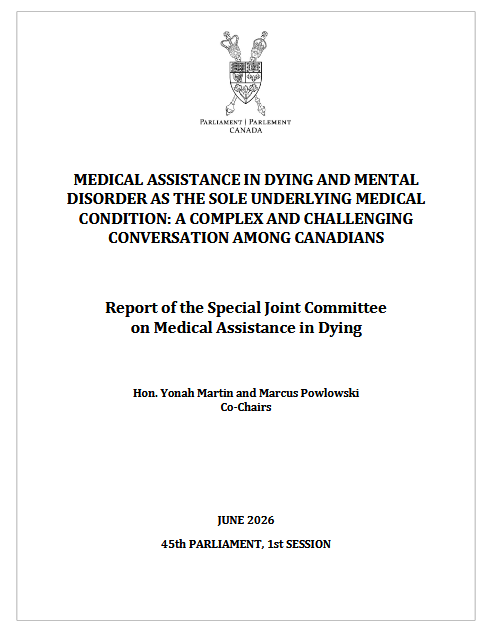
Canada has become internationally infamous for its high numbers of medically assisted deaths—and has for several years been poised to further expand access. But a special joint committee of diverse representatives in Canada recently issued its final recommendation to the federal government about providing medical assistance in dying (MAID) to people solely on the basis of their allegedly having “mental disorders” that are “irremediable.”
Previously, only people whose deaths were “reasonably foreseeable” due to a medical illness could get MAID. Then eligibility expanded to any person experiencing “a grievous and irremediable medical condition”—any medical condition that caused them a lot of suffering, even if it would not kill them. Then, the related proposal that anyone suffering from a “mental disorder” could get or be prodded towards MAID started generating more controversy in Canada than MAID itself.
The committee’s report reviews the main disagreements fairly well, if somewhat briskly. But it’s especially engaging reading for the opportunity it presents to see mainstream psychiatrists take different sides on this particular issue—and in so doing, ending up being, sometimes inadvertently, frank and honest with the government about the non-science of psychiatry in ways that we rarely see in such prominent venues. What happened in these debates needs to happen every time any legislated proposal emerges for protecting people’s mental health by taking away rights.
For example, some psychiatrists predictably reassured the government that they use rigorous diagnostic criteria and medical processes to determine who has an irremediable “brain” disorder and who doesn’t. But in this case—entirely unlike during most public policy debates about involuntary commitment—other psychiatrists from equally prestigious institutions refuted that assertion, pointing out that there are no “diagnostic markers and laboratory tests” for mental disorders. Both sides then openly admitted that “we can’t see the illness on a scanner,” and that determinations of the existence or non-existence of “mental disorders” are not truly medical but essentially subjective.
A similar frankness emerged around the ineffectiveness and harms of common psychiatric medications for those considered to have serious mental disorders. How can anyone say a mental disorder is truly “irremediable,” many experts pointed out with refreshing honesty, just because a person has tried a lot of psychiatric drugs, while never getting access to a wide range of other possible supports, services, and non-drug therapies?
The Canadian Psychiatric Association (CPA) presented the government committee with a test they’d developed. It involved a long, complex, nuanced series of investigations into a person’s life and circumstances through which, they said, psychiatrists could ultimately reliably distinguish between a person with a mental disorder who is seeking MAID and should be assisted, and one who has a mental disorder and is suicidal, and should be prevented from acting on that impulse and assisted with other supports and services.
In a critical retort, a psychiatrist from Canada’s largest psychiatric research hospital testified that the CPA’s test was merely “aspirational” – and there was no evidence suggesting it would ever realistically be used in practice or, even if it were, would work as intended.
“Aspirational,” indeed — I laughed aloud at the CPA’s test. But then, I also thought about how different, how much more profoundly compassionate and practically helpful involuntary commitment proceedings could become, if only psychiatrists did anything even remotely approaching such thorough investigations into the abuses their patients have experienced, the real life challenges they’re facing, and what types of supports they felt would truly help.
In the end, the Special Joint Committee on Medical Assistance in Dying issued a recommendation to “indefinitely exclude persons whose sole underlying medical condition is a mental illness from eligibility for medical assistance in dying.” The government has not yet signaled whether it will implement this recommendation.
Whether one agrees with the recommendation or not, here’s my over-arching point: The entire debate rests on the conviction that ideas about “mental health” and “mental disorder” provide a viable guiding framework for government to grant or withhold human and civil rights. And since the vast majority of us, allegedly, will meet the criteria for having a mental disorder at some point in our lifetimes, this conviction can affect many lives.
In this instance, the seriousness of assisted dying inflamed passions, created wide disagreements, and compelled many psychiatrists to speak out and expose some of the cracks in this conviction—but on many other political issues, such as banning youth from access to social media, it threatens to prevail unchallenged.
Thank you for reading! I’ve been posting here less frequently lately, in large part because I’ve been engaged in months of research for an upcoming story. Your support has helped make that work possible, too.
Psychiatrists have long claimed to be able to reliably identify disorders and predict outcomes but the evidence shows that they can't. In early April, while the Committee tasked with making a recommendation on mental illness and MAID was operating, I sent a letter to every member and a copy of Robert Whitaker's "Anatomy of an Epidemic" to the Chair. I got no response or acknowledgement.
I pointed out that for decades, citizens in Canada have accepted damaging and costly myths about mental illness, and that in 2010, Whitaker's book exploded these myths, which I then listed along with what the evidence actually shows. The most important fact is that most mental illness is iatrogenic.
Just like the US, Canada is experiencing an explosion of costly mental illness-related disability claims. These claims continue to rise in lockstep with increased psychiatric drug prescriptions. I concluded the (5-page) letter by noting that "Canada is already facing criticism for its expanding use of MAID. As state-sanctioned manufacture of serious disability continues to grow, demand for MAID is likely to increase. Canada should stop any thought of approving MAID for MD-SUMC, while we can."
Thanks, Rob, for pointing out the similarities between MAID and YOUR CONSENT IS NOT REQUIRED. It’s sad to know that people only register concerns when the government and medical interventions affect them directly.