
Good Riddance, "Deemed Consent"
The darkest, hardest, leading edge of forced treatment law in North America has been turned back

(1900 words/8.5 minutes reading)
I cut my teeth as a young journalist while working amid what has long been the most aggressive involuntary commitment legal regime in North America. In making their laws more aggressive, many other Canadian provinces and U.S. states have, over the decades, been following British Columbia’s (BC’s) legislative lead. The first time I learned of Treatment Advocacy Center (TAC), America’s most influential pro-force lobby group, it was because TAC was publicly praising how things were done in BC as a model for everyone.
But last week, after the conclusion of a court case I first reported on when it began more than a decade ago, key interlocking pieces of that regime were hacked out by the British Columbia Supreme Court. Everyone in North America who is concerned about expansions to forced psychiatric interventions can celebrate this shot across the bow to governments.
I found one particular thematic thread within the Court’s 350-page reasons for judgment especially revealing and instructive—and it’s something no other journalists or commentators seemingly noticed, let alone reported on. But it could prove to be the most relevant aspect of the decision guiding what happens next.

In the Court’s deep dive into the history of how this legal regime came about and how successive governments have defended it, we get a stark warning about how dastardly and deceptive governments will be when defending the broad powers of forced psychiatric treatment. These manipulative practices have been employed by right-leaning and left-leaning governments alike in BC, including by the current BC Attorney General (AG).
It’s a bleak lesson and cautionary tale with wide relevance, as the tactics on display are sadly and worrisomely similar to what we’re also seeing right now under Trump’s reshaped Department of Justice: governments, and leading government litigators, operating with increasing disregard for honesty, ethical principles, and the rule of law.
The decision, and why it came about
First, let’s be clear on what this case was not: It was not a legal challenge to forced psychiatric treatment writ large. The plaintiffs, the Council of Canadians with Disabilities (CCD), targeted only what they believed to be at once the most aggressive and the most constitutionally “vulnerable” aspects of BC’s forced treatment regime.
In BC, every involuntary psychiatric patient is automatically declared, upon admission, to lack any capacity whatsoever to make reasonable decisions. This is decided without anyone doing any actual assessment of the person’s mental competency.
Further, every involuntary patient is automatically “deemed” to “consent” to forced psychiatric treatment. Alarmingly, even if the patient has a legally appointed health care representative, a legally appointed substitute decision maker, and/or a legally binding advance directive for their health care, the treating psychiatrist can just ignore all of that, in all cases and circumstances.
As the presiding judge noted, BC’s “legislative scheme” gives “blanket power” to individual psychiatrists to force “any psychiatric treatment” they want to on “any involuntary patient in any situation.”
In practice, due to the widespread lack of accountability mechanisms in mental health systems, many involuntary psychiatric patients in other jurisdictions have also experienced bogus capacity evaluations, their chosen representatives getting pushed out, their advance directives being over-ridden, and so on—but BC has so far been unique in setting up an entire legal regime to explicitly authorize, reinforce, and uphold all of this happening automatically.
No longer.
Fortunately, and remarkably, this judge “got it.” I think many regular readers of PsychForce Report will know what I mean. Judge Lauren Blake did not completely succumb to the typical sanist tunnel vision that posits psychiatric patients as lesser citizens. Instead, she took the ideas, values, and ideals embodied in the United Nations Convention on the Rights of Persons with Disabilities (CRPD ) to heart. Even though the CRPD is not domestic law in Canada, Blake discussed the convention in her reasons, and placed the core issues of the case squarely within the broad context of universal human rights.
“The right to determine what shall, or shall not, be done with one’s own body, and to be free from non-consensual medical treatment, is deeply rooted in our common law,” Blake wrote. “Every capable adult has the right to refuse unwanted medical treatment, even if serious consequences may result from such a refusal. This common law right to bodily integrity and personal autonomy is so entrenched in our legal system it has been described as ‘fundamental’ and ‘deserving of the highest order of protection’.”
Therefore, key sections of the BC Mental Health Act (MHA) and two other laws were declared by the Court to be “unconstitutional,” “arbitrary,” “overbroad,” and “grossly disproportionate” for their purported intent, together functioning to “unjustifiably infringe upon the rights to life, liberty and security” of all people subjected to them.
The judge instructed that there will have to be a distinct process for evaluating each patient’s mental competency before forced treatment can be administered outside of short-term emergency situations. In addition, patients’ prior advance directives and chosen substitute decision makers will have legal standing.
The Court gave the government six months to rewrite the laws.
Looking into the history, however, one might reasonably be concerned about what will actually happen next.
Decades of dubious machinations by governments
As the Court’s decision lays out in detail, the BC provincial government created this broadly rights-stripping law in 1981. The new, key “deemed consent” section stated, “Where a person is detained in a Provincial mental health facility… treatment authorized by the director shall be deemed to be given with the consent of the person.”
And the government concealed this single-sentence section amid a slew of changes to other, unrelated laws inside what, in BC, is called a “miscellaneous statutes amendment bill.” These are like massive omnibus bills, except they’re usually supposed to be reserved for simple “administrative cleanup” tweaks to many, varied laws. As a result of this ruse, the government managed to evade having any discussion in the legislature of this change to the MHA.
It was another three years before the government even bothered to create a form for psychiatrists to fill out that officially stated and notified patients that this all-powerful clause to allow forced treatment with their “deemed consent” was being invoked.
And this form was merely a rubber-stamping exercise, anyhow. The judge noted that even the AG’s own expert witness acknowledged that the form simply helped psychiatrists manufacture a “legal fiction” in which patients were declared to be incapable even when they were capable.
Meanwhile, behind the scenes, the government already knew the law was unconstitutional. In 1982, the Province’s own then-Director of Legislation and Regulation for Mental Health Services at the Ministry of Health had proposed deleting the “deemed consent” section from the MHA. The director described the rights-stripping sentence and the legal regime it set up as “contentious and constitutionally vulnerable” and said the government’s internal legal experts unanimously agreed that the “deemed consent” clause was a “flagrant ‘Achilles heel’” in the MHA.
Nevertheless, the government declined to remove the section.
Then, in the 1990s, there were major public consultations amid a full review of the MHA, a Draft Report and discussion paper produced, and a Consultation Committee convened—all of which flagged these issues.
And all of that, in the end, was simply dismissed.
Then, in a seminal court case in 2005, an involuntarily committed patient won damages for breaches of his rights, and the judge in that case noted that the BC MHA was a “badly drafted piece of legislation” that made it difficult even to determine reliably what rights patients had.
And still, the MHA was not rectified.
As for those aforementioned forms that psychiatrists were supposed to fill out, to at least nominally notify patients of how their rights were being taken away, and on what grounds, and with what intentions: In 2018, an independent review by the BC Ombudsperson found that 24% of patient files did not contain the required form at all, and only 1% of the others were properly completed. And in a subsequent review, four years later, only nominal improvements in practices had occurred.
This pattern of disregard for the law continued during the trial proceedings.
During the trial
The BC government’s stalling tactics caused this precedent court challenge to drag on for a decade. The BC AG tried to get the plaintiff disqualified from bringing the challenge, to get the plaintiff’s experts disqualified, and to get the Ombudsperson’s independent evaluations thrown out.
The AG told the Court that it was “impossible to imagine any other manner of delivering involuntary treatment”—even though every other jurisdiction in North America does it differently.
The AG provided no evidence that its forced treatment regime created positive outcomes. And the judge said that the AG “did not engage in a meaningful way” with key evidence, and made “broad” statements “untethered to the evidence.” At times, the judge observed, the AG implied the legal proceedings were meaningless and that “nothing would change” in BC’s involuntary commitment practices as a result of any decision by the Court, while at other times the AG threatened that a decision not in the government’s favor would be sweepingly “catastrophic.”
Then came the coup de grâce—on the day when final closing arguments were about to be presented, the government brought a bill into the provincial legislature to remove the “deemed consent” section from the legislation altogether. And the government pledged to pass the bill within days.
Shockwaves rocked the courtroom—and news media and outside commentators were largely baffled, as the government’s publicized rationale made little sense. What now?
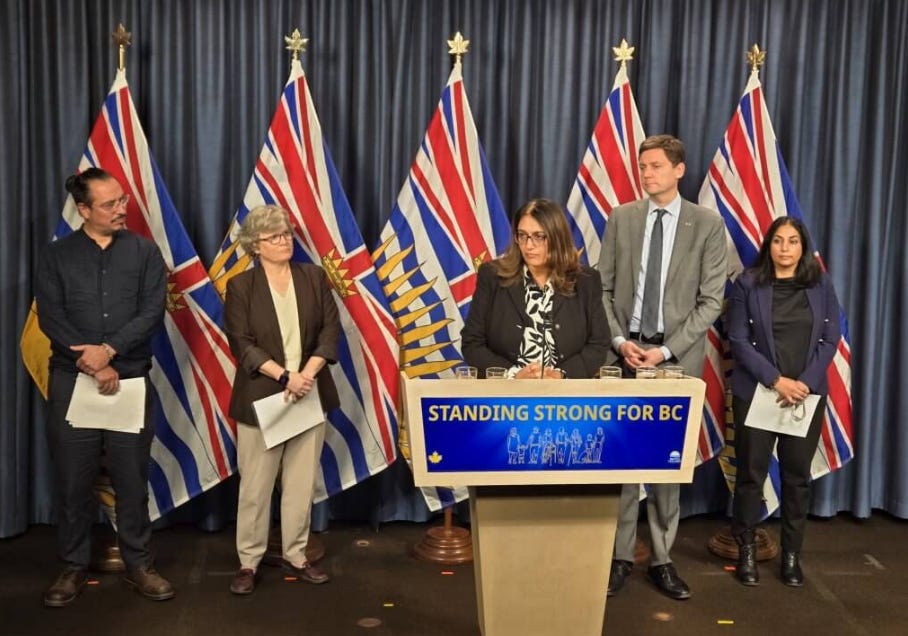
The judge described the government’s sudden repeal of the key “deemed consent” section—announced literally on the final day of the trial—as an “unprecedented” action. And it also seemed utterly perplexing—because at the same time, the government insisted publicly that nothing in BC’s forced treatment regimens would change. So why did they abruptly remove the sentence at all?
In the courtroom, the rationale quickly became clear. The AG proceeded to argue that the particular sentence that had been under debate in the court for a decade did not actually confer the “deemed consent” powers. Instead, the AG suddenly claimed, it was a different section in the legislation that actually conferred those powers. Consequently, the AG argued to the Court, the CCD “should be required to amend their pleadings and file a new notice of constitutional question.”
Basically, the government was trying to do an end-run around the case with this technicality, and compel the entire proceedings, after ten years, to go back to square one and start all over again.
Fortunately, the judge didn’t fall for the ruse. “The reality is that BC continues to provide treatment to patients who are involuntarily admitted in the same manner as before the repeal [of the ‘deemed consent’ section],” the judge noted. Consequently, the judge ordered closing arguments to wrap up, and proceeded to rule on the broader issue before the Court, rather than only on the abruptly disappeared sentence.
Conclusion
Based on this long history of governments’ dubious behaviors, it’s difficult not to be cynical and suspect the BC government might find a way, over the next six months, to concoct a new legal regime that’s somehow the same or worse. So perhaps one of the biggest positives is that the judge also granted the CCD’s attorneys their costs. Presumably, then, the same legal team would potentially be willing to take on another challenge to BC’s MHA.
But if you ever wonder what sort of corruption might lie behind involuntary commitment laws and practices that seem abusive of basic rights guaranteed under your country’s constitution in other contexts, this case provides bleak but instructive testimony. It reveals just how intensely governments want to retain such broad powers to take away citizens’ rights while using the flexible excuse of “protecting people’s mental health”—even if that means, along the way, bending and breaking the law themselves.
Criminals have more rights than “mental health” patients. And we wonder why there is so much stigma attached to so-called mental health conditions. Ha. The entire legal and psychiatric professions openly declare people mentally incompetent every day of the year—without a stitch of scientific evidence. Stigma doesn’t originate among the ignorant unwashed masses; it is completely fabricated by the unscrupulous professionals. Makes me vomit. 🤮
Great summary of the case and the effect on the law. This case had another positive effect that resulted from another attempt of the government to overthrow it. As often happens with legal cases involving mental health rights, the particular individual in whose name the case was launched reached a point where they no longer wanted to pursue the case. This happens for perfectly understandable reasons - not many want their name and mental health history spread across the country for many years. CCD along with MANY public interest intervenors (of which we were one) argued that for this and other reasons organizations should be allowed to bring forward potential Charter violations. Our side won (yay!) and therefore CCD was allowed to carry on with the case without having to begin all over again.